
This was an article I had written for a magazine. However as the theme of the issue was heading in a different direction, I chose to still keep my work and use it for my blog, to show another aspect of my writing.
Fashion and Fetish are two very huge ideas. In order to understand them, we need to understand each concept in its own right. Fashion is often used to describe a popular clothing style that is prevalent at any given time. It is never used to identify negative style, but to categorize the relevant present fashions and the “retro” fashions; styles which are not so current anymore.
Whilst some styles are considered to be “fashionable”, and others are “unfashionable”, this merely presents personal opinion of an individual. Everyone has some quirkiness to their own style, as it is what makes them individual. Fashion gives us options. It allows for choice and for change and eccentricity. The fact that there are many established and undiscovered designers in the world simply proves that there are options available for everyone, and each views fashion differently.
Fashion, whilst on the overview is used for everyday wear; there are many different levels available. Fashion is a form of art, a way to express emotion and character. This can reach new heights and doesn’t have to obey any boundaries; the idea is to fully express personality and emotion. Costume fashion is very admirable for this very reason, as it is to be praised solely for its uniqueness and extreme appearance.
Fetish on the other hand, is commonly assumed to be closely related to eroticism. However, there is far more to it than just this. Fetish can be used to describe anything which is considered to have an excessive reverence, anything whereby the attention is given excessively and obsessively towards something.
When trying to define how the terms Fashion and Fetish are related, their descriptions often cause them to become pigeon holed. Fetish fashion is very distinctive in its own right. Some aspects of this style have been created for routine use of women in order to improve their appearance, such as corsets and high heels. The advantage to these, is whilst they make a woman feel and look more womanly, they genuinely do improve their postures, allowing them to stand tall and confident. The other extreme to fetish fashion is the art form creations. These are much more costume based. In this way, the fetish fashion is viewed more as a type of second skin; a protective armour that shows respect for strong women. Whilst it has never been considered mainstream, many renowned designers including Vivienne Westwood and Dolce & Gabbana have created their own inspired versions of fetish fashion which was viewed on the catwalks and profoundly admired.
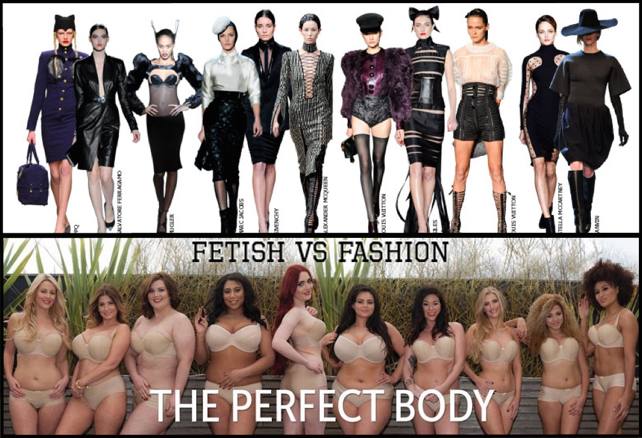
Whilst a fetish fashion can demonstrate outrageous costumed clothing, it can also refer to the psychological fixations that both men and women can struggle with to be the “perfect” size, portrayed mostly through the media. This obsessive behaviour is the fetish. It becomes a fashion fetish because it is considered to be an “acceptable” excessive activity; the lengths that some will endeavor to reach.
Emotions play a huge part in fashion. When it comes to style, a person’s fashion can express their emotions overtly. A person can appear proud and confident when wearing a style that complements them. Especially in the case of fetish fashion clothing, a deep regard for strong women allows them to carry off this style with grace and elegance.
When describing the emotive side to fetish fashion behaviour, we regard the image of “real women”. This can mean the emotions behind their actions. In order for them to have such hugely psychological fixations, they have absolute raw passion to achieve this “perfect” size. With the clothing, this raw passion is overtly pursued.
Within the media today, there are many celebrities that incorporate some of this fetish fashion into their own style. Lady Gaga is hugely recognized for her individual fashion style; her own personal fetish. She is often criticized for not conforming to the majority; however this is what makes her unique. Fashion should explore an individual’s personality rather than single them out to be outcasts. With her courage to wear such expressive costumes, Lady Gaga flaunts her confidence. In this way, she uses her fashion to mask the person she really is. So we must ask is this the “real woman” behind Lady Gaga, or just a stage persona she has created. Again this allows us to think of the idea of fetish fashion as a second skin; a protective armour.
The general public assumes that a “real woman” is someone who is fuller figured and an average size 14. In many eyes, she is considered overweight. This is a huge opinion regarded by a majority. Who is to say that a “real woman” isn’t someone that is a size 8? These women can still conceive, and this is our main purpose as women of the world. All of these views stem from solid opinions throughout the years. However, personally I feel that the concept of a “real woman” is someone who is self assured. A woman who can carry this provocative style of clothing confidently. With this style, there are no boundaries, as its excessive nature is what makes it unique.
The main idea that seems central to this research is the idea of knowing “when to stop”. Fashion fetish clothing, though very outrageous, still holds boundaries, as “too far” can cause the designs to go from classy to tacky. These extravagant pieces are works of art to be admired and a form of “fashionable” art.